UNC researchers develop an AI-powered digital health index to identify communities overlooked by existing measures
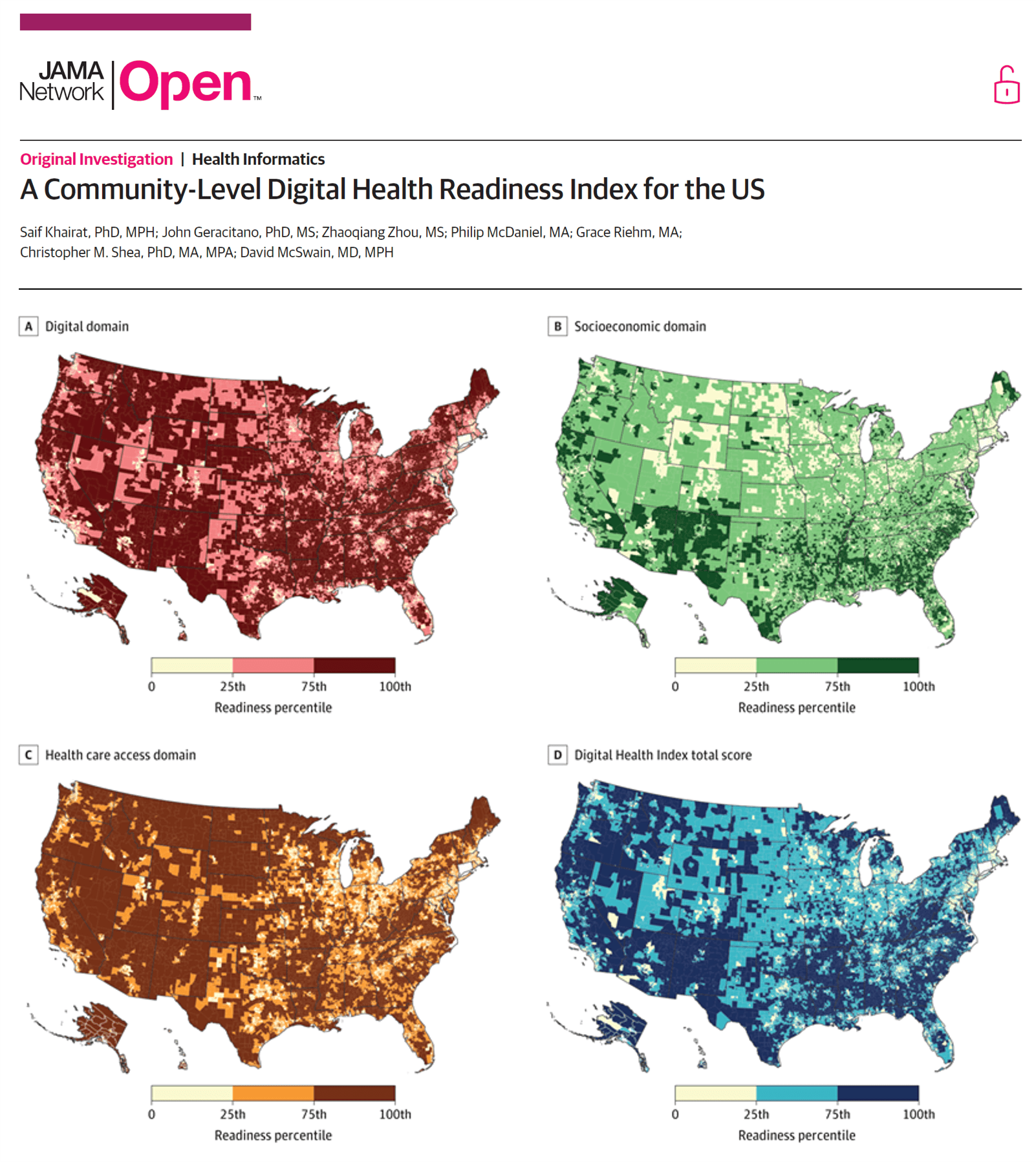
As health care delivery shifts toward digital health such as telehealth, remote monitoring, and AI-enabled services, no standardized measure has existed to assess whether communities are equipped to access and benefit from these technologies. The gap leaves resource allocation and intervention planning without an evidence base.
The Digital Health Index (DHI) fills that gap. Published in JAMA Network Open and developed with support from the NCATS RC2 award to the UNC ViVE Center, the DHI is an AI-powered composite index validated across all 85,396 U.S. census tracts. Built from 21 indicators confirmed through a two-round Delphi panel of 37 national experts, it integrates digital connectivity, health care access, and socioeconomic conditions, domains that existing indices treat separately or omit.
Between 56% and 67% of the most digitally vulnerable communities in the country do not appear in existing tools. Led by Dr. Saif Khairat, PI of ViVE Center at UNC, the research compared DHI results against the Social Vulnerability Index (SVI), Area Deprivation Index (ADI), and Digital Deprivation Index (DDI). Only 33-44% of census tracts flagged as highest-need overlapped. Communities with lower DHI scores also carried higher per-capita health care costs, grounding the index in economic outcomes, not demographic proxies alone.
The DHI is built entirely from publicly available data, reproducible by any health system or federal agency, and updatable as infrastructure conditions change. It gives policymakers, health systems, and community leaders a census-tract-level instrument to direct digital health investment where existing tools have created a systematic blind spot.
The DHI is operationalized through a publicly accessible web portal that provides community-level insights, generates reports, and offers AI conversational agents for efficient information retrieval.
Digital Health Index (DHI): dhindex.com
JAMA Network Open: doi.org/10.1001/jamanetworkopen.2026.19372
Originally posted at ccos-cc.ctsa.io